Every papal journey to Türkiye is far more than a protocol stop on a diplomatic calendar.
In Nicaea, a 1,700-year-old creed was shaped; in Ephesus, the House of the Virgin Mary watches over a quiet valley; and in Istanbul, mosques, churches and a patriarchate share the same skyline.
Taken together, these layers do not simply make Türkiye a country that delegations “pass through”. They place it in a distinct position on the global map of Christian heritage and pilgrimage routes.
The most recent visit of Pope Leo XIV between 27–30 November 2025 fits exactly into this frame:
-
In Nicaea (Iznik) he marked the 1700th anniversary of the First Council of Nicaea,
-
In Istanbul, he visited the Sultanahmet (Blue) Mosque and met Christian leaders,
-
Along the way, he echoed themes of unity, dignity and mutual respect.
This article is not a theological statement and not a policy proposal.
Sacred Routes Turkey is a cultural and production initiative that respects the legal and sovereign framework of the Republic of Türkiye.
Our aim is to interpret this multi-layered heritage for cultural diplomacy, faith-based travel and documentary projects — always within that framework.
With that in mind, we read the journey of Pope Leo XIV through three key waypoints: Nicaea, Ephesus and Istanbul.
1. Why Pope Leo XIV’s Visit to Türkiye Matters
Modern relations between the Holy See and Türkiye have become visible above all through papal journeys. Officially recorded visits include:
-
1967 – Pope Paul VI
-
1979 – Pope John Paul II
-
2006 – Pope Benedict XVI
-
2014 – Pope Francis
-
2025 – Pope Leo XIV
This makes Türkiye one of the few countries visited by five different popes.
While each journey had its own context, some common themes run through all of them:
-
A call for Christian unity and dialogue,
-
A message of mutual respect with the Muslim world,
-
Recognition of Türkiye’s central role in the history of early Christianity.
The 2025 visit by Pope Leo XIV added two very specific layers:
-
A solemn commemoration of the 1700th anniversary of the Council of Nicaea in Iznik,
-
A renewed emphasis on solidarity among Christian leaders in Istanbul, without ignoring the sensitivities of the wider region.
2. Nicaea (Iznik): The Council, the Creed and a Living Landscape
To most visitors today, Iznik feels like a tranquil lakeside town.
In Christian memory, however, Nicaea is the city where a foundational creed was debated and adopted: the First Council of Nicaea (AD 325) and the Nicene Creed.
2.1 Pope Leo XIV and the 1700th Anniversary
During his 2025 itinerary, Pope Leo XIV treated Nicaea not as a nostalgic backdrop, but as a stage for a renewed call to Christian unity.
Standing together with the Greek Orthodox Patriarch and other church leaders, he joined in the recitation of the Nicene Creed — first formulated here seventeen centuries ago. For many observers, this moment symbolised:
-
Dialogue between Catholic and Orthodox traditions,
-
A desire to bridge long-standing divides between Eastern and Western Christianity,
-
An appeal for peace in a century marked by fragmentation and conflict.
2.2 Reading Nicaea as a Pilgrimage Stop
For pilgrims and curious travellers today, Nicaea offers several focal points:
-
Historical references to the Council of Nicaea,
-
The submerged basilica beneath the waters of Lake Iznik,
-
Layers of Byzantine, Seljuk and Ottoman heritage in the town’s walls, mosques and civic buildings.
All of this exists within the sovereign and legal framework of the modern Republic of Türkiye, where diverse religious and cultural legacies share the same geography.
From the perspective of Sacred Routes Turkey, Nicaea is not merely a site where history is “explained”. It can be approached as:
-
The place where a key statement of Christian belief was formulated,
-
A setting where aspirations for Christian unity are remembered,
-
And a landscape where calls for peace and reconciliation can be voiced in our own time.
This reading does not assert any theological claim or advocate any official policy. It simply interprets historical heritage through the eyes of contemporary visitors and filmmakers.
3. Ephesus and the House of the Virgin Mary: A Shared Place of Reverence
Almost every papal journey to Türkiye has included a common stop: Ephesus and the House of the Virgin Mary.
Pope Paul VI (1967), Pope John Paul II (1979) and Pope Benedict XVI (2006) all visited this hilltop sanctuary near Ephesus and celebrated Mass there.
3.1 The House of the Virgin Mary: A Bridge Between Communities
For the Catholic world, the House of the Virgin Mary is an officially recognised pilgrimage site.
What makes it truly unique, however, is that it is also a place of deep respect for many Muslim visitors:
-
Mary (Maryam) holds a special and honoured place in the Qur’an,
-
Turkish visitors often come to the site for prayer, vows and personal petitions.
In this sense, the House of the Virgin Mary has become an informal bridge between communities, without erasing their differences.
When Pope Benedict XVI celebrated Mass here in 2006 and spoke about peace and reconciliation, Ephesus ceased to be just an “ancient city” and became a living meeting point in the present.
3.2 Where Ephesus Fits in the Sacred Routes Turkey Universe
Within the Sacred Routes framework, Ephesus connects several itineraries:
-
Seven Churches of Revelation – Ephesus as part of the early Christian communities of Asia Minor,
-
Virgin Mary & Ephesus – combining the House of the Virgin Mary, the ancient city and the Selçuk region,
-
Christian Heritage & Interfaith Dialogue – exploring Mary as a shared figure of respect across faiths.
In this context, Pope Leo XIV’s route places Ephesus and the House of the Virgin Mary at the heart of a modern pilgrim’s question:
“When we come to Mary here, are we only looking back at history –
or also searching for a way to live together with more dignity today?”
4. Istanbul: Between the Blue Mosque, Hagia Sophia and the Fener Greek Patriarchate
Some of the most striking images from Pope Leo XIV’s journey through Türkiye come from Istanbul.
4.1 The Blue Mosque and the Silence of Prayer
In both 2006 and 2014, Popes Benedict XVI and Francis visited the Sultanahmet (Blue) Mosque and paused there in silent prayer. Those images travelled around the world as a powerful symbol of mutual respect between Muslim and Christian believers.
During his 2025 visit, Pope Leo XIV entered the Blue Mosque without shoes like every visitor. Unlike his predecessors, he chose not to pray publicly, but to experience the space in silence. This was widely discussed in the media, yet the underlying message remained clear:
-
Respect for the sacred character of the mosque,
-
Sensitivity to different expectations within and beyond Türkiye,
-
A desire to let the place speak for itself, without additional gestures.
4.2 The Fener Greek Patriarchate and the Search for Christian Unity
Istanbul is also home to the Fener Greek Patriarchate.
Popes John Paul II, Benedict XVI, Francis and Leo XIV all met the Patriarch here and signed joint declarations, underlining a shared desire for closer ties between Christian traditions.
Across these meetings, two recurrent ideas can be heard:
-
Historical differences are real, but do not need to be permanent,
-
Church leaders are called not to deepen division, but to cultivate dialogue and understanding.
For Sacred Routes Turkey, Istanbul therefore becomes:
-
A city where imperial mosques, Byzantine churches and modern neighbourhoods coexist,
-
A setting where the Blue Mosque, Hagia Sophia, Fener, Armenian and Syriac churches can all be read as part of a single, complex story,
-
A natural stage for documentaries and carefully designed study journeys.
5. Turning a Papal Journey into a Pilgrimage Route
If we translate Pope Leo XIV’s journey into an itinerary, a strong and coherent route appears — valuable for both pilgrims and documentary teams:
-
Nicaea (Iznik)
-
Commemorating the Council of Nicaea,
-
Exploring the historical background of the Nicene Creed,
-
Visiting the lakeside basilica and the town’s mixed architectural heritage.
-
-
Ephesus & the House of the Virgin Mary
-
Following the traditions of Paul and John,
-
Understanding the Marian devotion that shaped papal visits,
-
Observing how Muslim and Christian visitors share the same site.
-
-
Istanbul
-
Reading the symbolism of the Blue Mosque and Hagia Sophia,
-
Visiting the Fener Greek Patriarchate and other historic churches,
-
Experiencing a truly multi-religious and multi-layered city.
-
In this sense, the route followed by Pope Leo XIV confirms a broader intuition:
“For Christian pilgrimage routes, Türkiye is not just another stop;
it is one of the main stages on which the story unfolds.”
This statement does not assign any new theological status to the country, nor does it suggest an official redefinition of its identity. It simply reflects how many visitors, scholars and filmmakers experience this landscape when they walk in the footsteps of papal journeys.
6. For Documentary Teams: “In the Footsteps of Pope Leo XIV”
Beyond pilgrimage, Sacred Routes Turkey also supports documentary and film projects as a local production partner.
Along the route followed by Pope Leo XIV, several documentary concepts naturally emerge:
-
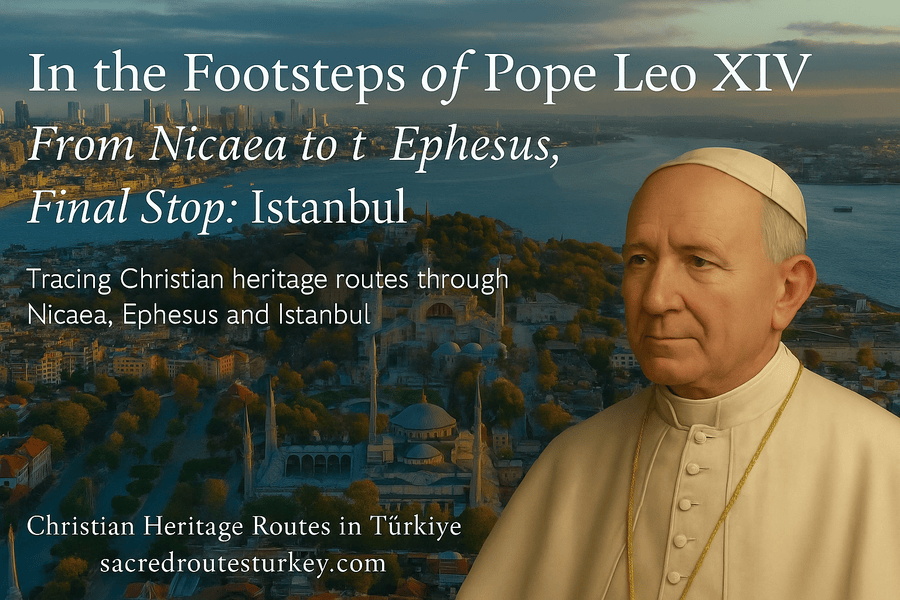
“In the Footsteps of Pope Leo XIV: From Nicaea to Ephesus, Final Stop: Istanbul”
A journey tracking the main waypoints of the 2025 papal itinerary across Türkiye. -
“In the Footsteps of the Nicene Creed”
Exploring the legacy of the Nicaea Council and the Christian communities that still live in its shadow. -
“Mary Between Cross and Crescent”
Following stories of Muslim and Christian pilgrims at the House of the Virgin Mary near Ephesus. -
“A City of Many Altars”
A one-day journey through Istanbul: mosques, churches, synagogues and the patriarchate from Fener to Balat, Karaköy and Sultanahmet.
For such projects, Türkiye offers:
-
Locations that combine extraordinary visuals with deep historical layers,
-
Narratives that connect past and present, belief and everyday life,
-
Dialogues that can be framed with sensitivity and respect.
Sacred Routes Turkey — together with the broader Turkish production ecosystem — can support these projects with:
-
Route design and research,
-
Permit guidance in line with local regulations,
-
Local crews, logistics and on-the-ground production services.
7. Conclusion: Not Just Watching the Visit, but Reading the Route
News headlines about papal visits tend to fade quickly.
Yet Nicaea, the House of the Virgin Mary and Istanbul’s skyline of domes and minarets remain, carrying more than 2,000 years of layered history.
The perspective of Sacred Routes Turkey is simple:
-
Do not reduce Pope Leo XIV’s visit to a single news cycle,
-
Instead, read it as a window into deeper routes that run across Nicaea, Ephesus and Istanbul,
-
And recognise the opportunity this creates for carefully designed journeys and thoughtful visual storytelling.
If you would like to:
-
Design a pilgrimage or study tour that follows these footsteps,
-
Develop a documentary or TV project along the Nicaea–Ephesus–Istanbul axis,
-
Or simply explore these sites with a group that values history, faith and culture,
Sacred Routes Turkey would be honoured to help you shape a route that respects both the sensitivity of the sites and the legal framework of the Republic of Türkiye.